
“When you start a new website, learning how to choose a blog niche is the most important step
In today’s world, writing about any subject has become much easier. You can comfortably sit at home and start writing online as a blogger.
However, the problem arises when you try to understand people’s interests and needs. How do you know what they would like to read? Until you understand this, it is difficult to create content that attracts readers.
It is just like the traditional publishing industry. In the past, if a book’s subject didn’t appeal to readers, it didn’t sell. The same principle applies here. Your personal interests may be different from those of other people, and it is not necessary that everyone will like what you like.
If you want to earn money through your writing, you should combine your interests with your readers’ interests. Only then will you be able to sustain your writing journey.
Otherwise, many people start writing blogs and continue for some time, but they fail to attract readers. Gradually, they stop updating their blogs, and eventually, those blogs become inactive. In such cases, both time and money are wasted.
To choose a profitable blog niche, combine five things: Before writing any blog, it is essential to know what topic it will cover. To choose a profitable blog niche, we should keep the following five points in mind: 1. genuine knowledge or willingness to learn deeply 2. A clearly defined audience 3. Topics people actively search for 4. manageable competition 5. Monetisation options that fit that audience. A trend may help you find an opportunity, but it should not be the main reason you choose your niche. Google’s guidance similarly emphasises creating content for people with a clear site focus, rather than publishing across unrelated topics simply because they appear popular. Choose a blog niche
how-to-choose-a-blog-niche
What Is a Blog Niche?
A blog niche is the specific subject area and audience your blog serves. It is narrower than a broad topic and gives readers a clear reason to return.
For example:
| Broad topic | Focused blog niche |
| Personal finance | Budgeting for college students |
| Education | Career guidance for agriculture graduates |
| Technology | Practical tutorials for small-business owners using free software |
| Health and fitness | Home workouts for busy parents |
| Food | Easy vegetarian meal prep for working professionals |
A good niche is not necessarily tiny. It can cover a broad subject, but it should have a recognisable audience and a consistent purpose. “Personal finance” is a field; “budgeting for first-year college students” is a niche because it identifies both the topic and the reader.
Why Following Trends Blindly Can Hurt Your Blog
Trends can be useful signals, but building an entire blog around one can create several problems:
- Short-lived demand: Search interest may rise quickly and disappear just as quickly.
- Intense competition: Popular trends often attract established websites, creators, and news publishers.
- Weak topical focus: A blog that jumps from one trend to another may confuse readers and search engines about its main purpose.
- Limited expertise: Writing about a subject only because it is popular can lead to shallow, inaccurate, or generic content.
- Poor monetisation fit: High attention does not always mean readers will want relevant products, services, or in-depth resources.
Google specifically advises creators not to write about something merely because it is trending; instead, use trend data to determine whether the topic fits the site’s purpose and audience.
Trends become useful when they connect to your long-term niche. For example, if your blog helps students manage money, a trend around a new budgeting app may deserve coverage. But if your blog is about home gardening, that app is probably unrelated—even if it is receiving substantial attention.
7 Factors to Consider Before Choosing a Profitable Blog Niche

Choose a blog niche
No single factor guarantees profitability. The strongest niches usually perform reasonably well across all seven factors below.
1. Knowledge, experience, and genuine interest
Choose a subject where you have useful experience, professional knowledge, or a serious commitment to learning. You do not need to be the world’s leading expert, but you should be able to add original value through practical explanations, personal context, research, or a distinct point of view.
Example: A teacher may be well positioned to write about classroom resources, study techniques, or career preparation for students. A person with no teaching background may still write about education but will need to invest much more time in research and credibility.
2. A clearly defined audience
Ask: Who exactly is this blog for?
“Everyone interested in fitness” is too broad. “Beginners who want simple home workouts without gym equipment” is clearer. A defined audience makes it easier to choose topics, write in a helpful tone, recommend relevant resources, and build trust.
3. Real problems people search to solve
Profitable blogs usually help readers complete a task, make a decision, learn a skill, or solve a recurring problem. Look for questions such as:
- How do I create a monthly budget as a student?
- Which free tools can help a small business manage invoices?
- How do I prepare for a specific entrance exam?
- How do I start a balcony garden in a small apartment?
If people are actively looking for answers and existing content does not fully help them, you may have a content opportunity.
4. Search demand and evergreen potential
Use keyword research to understand whether people search for the topic throughout the year or only during short seasonal peaks. Google Trends can show search-interest patterns, related topics, and rising queries; Google advises using it to inform strategy rather than choosing topics solely because they are trending.
Evergreen blog niches tend to address ongoing needs: career development, budgeting basics, software skills, home organisation, study methods, and practical hobbies. Seasonal topics can still work, but they should complement evergreen content rather than form the entire blog.
5. Competition and your opportunity to improve
Competition is not automatically bad. It can show that an audience exists. The key question is whether you can create something more useful, current, specific, or better organised than what already ranks.
Look for gaps such as:
- Existing articles are too general.
- Information is outdated.
- Important steps are missing.
- The content does not match the searcher’s actual need.
- No one addresses a particular audience, region, budget level, or skill level.
6. Realistic monetisation options
Before committing, consider whether the niche has plausible blog monetisation strategies, such as display advertising, affiliate marketing, digital products, memberships, sponsored content, consulting, or services.
A niche does not need high advertising rates to be viable. A smaller audience with a strong need for a specific course, template, tool, or service can be more sustainable than a large audience with no clear reason to buy anything.
7. Your ability to publish consistently
A blog niche requires ongoing work: research, writing, updating, answering reader questions, and improving older articles. Choose a niche you can realistically write about for at least 6–12 months.
A practical test: list 20 article ideas before starting. If you struggle to reach 10 meaningful ideas, the niche may be too narrow—or you may not yet know the audience well enough.
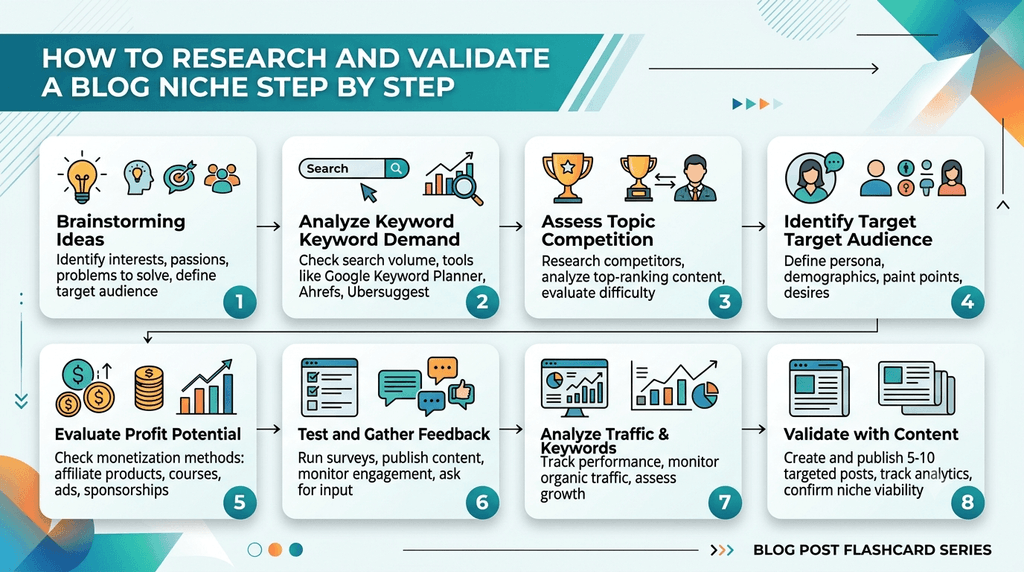
How to Research and Validate a Blog Niche Step by Step
Choose a blog niche
Here is a simple process for how to validate a blog niche before investing months of effort.
Step 1: List five candidate topics.
Write down five subjects you understand, enjoy, or are willing to research seriously. Include a short note about your connection to each one.
Example:
- Budgeting for college students
- Career guidance for agriculture graduates
- Beginner-friendly spreadsheet tutorials
- Home organisation for renters
- Study strategies for competitive exams
Step 2: Define the audience for each topic.
For each idea, complete this sentence:
“This blog helps [specific audience] achieve [specific outcome] through [type of help].”
Example: “This blog helps first-generation college students manage limited monthly expenses through simple budgeting systems and low-cost meal ideas.”
Step 3: Collect at least 20 real questions.
Use sources such as:
- Google autocomplete suggestions
- “People also ask” results
- Reddit, Quora, Facebook groups, and YouTube comments
- Student forums, professional communities, or niche-specific groups
- Questions from friends, colleagues, students, or customers
Record the exact wording people use. These phrases often become article titles, FAQs, and content clusters.
Step 4: Check search demand and related queries.
Use Google Trends to compare interest over time and identify related queries. Its Explore tool lets you compare terms, view geographic interest, and review “Top” and “Rising” related topics and queries.
Use Google Keyword Planner to explore keyword ideas and view estimates of search volume and advertising cost. Google describes Keyword Planner as a tool for discovering keywords and viewing estimates of searches and targeting costs.
Treat these figures as directional estimates. They do not guarantee traffic, rankings, conversions, or income.
Step 5: Study the current search results.
Search your main topics and review the first page carefully. Ask:
- What do the top articles cover well?
- What important questions do they leave unanswered?
- Are they current, accurate, and easy to follow?
- Could you add original examples, templates, checklists, local context, or a clearer structure?
- Do the results match informational, commercial, or transactional intent?
Avoid copying competitors. Your goal is to identify what readers still need after reading the available content.
Step 6: Check monetization fit
For each niche, note possible monetization routes:
- Display advertising
- Affiliate partnerships for relevant tools or books
- Original digital products, such as templates, checklists, planners, or courses
- Memberships or newsletters
- Coaching, freelance services, or consulting
- Sponsored content, where permitted and clearly disclosed
If you cannot identify at least two realistic monetization paths, research further before committing.
Step 7: Publish a small test group
Create 5–10 high-quality articles that address the most important audience questions. Make them genuinely useful, well organized, and updated when needed. Then evaluate engagement, search visibility, reader feedback, and whether you can continue producing strong content.
This is an initial validation period, not a promise that the blog will rank or earn money.
How to Evaluate a Niche Before Investing Your Time
Use this simple evaluation table before committing to a niche.
| Evaluation factor | Questions to ask | Evidence to look for | Warning signs |
| Audience demand | Do people search for this topic and ask questions about it? | Repeated questions, related searches, active communities, stable or growing interest | Interest exists only during a short trend cycle |
| Expertise | Can you explain the topic accurately and add original value? | Relevant experience, training, research ability, or a credible learning plan | You know almost nothing and have no plan to learn |
| Competition | Can you offer something better or more specific? | Content gaps, outdated pages, underserved audience segments | Every result is from a highly authoritative site with little room for improvement |
| Monetization | Are there relevant products, services, or advertising opportunities? | Relevant tools, courses, services, local businesses, or digital-product ideas | High traffic potential but no logical reason for readers to spend money |
| Content depth | Can you create many useful articles beyond surface-level topics? | At least 20 meaningful article ideas and clear topic clusters | Only a few obvious ideas or repetitive subjects |
| Long-term sustainability | Will you still care about this topic after several months? | Genuine interest, professional relevance, or a long-term learning goal | You chose it only because it is currently popular |
Simple niche scoring worksheet
Rate each factor from 1 to 5, where 1 means weak and 5 means strong:
| Factor | Niche A score | Niche B score |
| Personal knowledge or learning commitment | 4 | 2 |
| Clear audience | 5 | 3 |
| Ongoing search demand | 4 | 5 |
| Manageable competition | 3 | 2 |
| Monetization potential | 4 | 5 |
| Content depth | 5 | 3 |
| Long-term interest | 5 | 2 |
| Total | 30 | 22 |
In this hypothetical example, Niche A is not perfect, but it has stronger foundations. Niche B may have higher apparent demand and monetization potential, but weaker expertise, competition, content depth, and sustainability make it riskier.
Choose a blog niche
Profitable Blog Niche Examples for Beginners
These are niches worth researching, not guaranteed profitable opportunities. Their viability depends on your knowledge, audience, competition, and execution.
Career guidance for a defined audience
- Audience: College students, recent graduates, or career changers in a particular field.
- Sample articles: “How to Build a Resume for an Entry-Level Marketing Job,” “Internship Interview Questions for Engineering Students,” “Career Paths After a Agriculture Degree.”
- Possible monetization: Resume templates, interview-preparation guides, online courses, affiliate links to learning platforms, career coaching, or relevant services.
Practical software tutorials
- Audience: Beginners using spreadsheets, design tools, productivity apps, or business software.
- Sample articles: “How to Create a Monthly Budget in Google Sheets,” “Beginner’s Guide to Canva for Small Businesses,” “How to Automate Repetitive Tasks with Free Tools.”
- Possible monetization: Affiliate partnerships, templates, paid tutorials, courses, and display advertising.
Personal budgeting and financial education
- Audience: Students, young professionals, families, or first-time earners.
- Sample articles: “How to Create a Simple Monthly Budget,” “Emergency Fund Basics for Beginners,” “How to Compare Student Loan Repayment Options.”
- Possible monetization: Affiliate partnerships, budgeting templates, courses, and advertising.
Finance is a sensitive topic. Content involving money, investments, taxes, loans, or insurance should be accurate, clearly sourced, and careful not to give personalized financial advice unless you are qualified to do so.
Skill development and professional learning
- Audience: People learning a specific workplace skill, such as data analysis, public speaking, writing, coding, or digital marketing.
- Sample articles: “How to Learn Excel for Office Work,” “A Beginner’s Study Plan for Data Analysis,” “How to Practice Public Speaking at Home.”
- Possible monetization: Course affiliates, study guides, practice worksheets, digital products, and paid communities.
Home organisation and practical lifestyle solutions
- Audience: Renters, parents, students, or people with limited space and budget.
- Sample articles: “Small-Space Storage Ideas for Renters,” “A 30-Day Home Decluttering Plan,” “How to Organize a Shared Kitchen.”
- Possible monetization: Affiliate links to storage products, printable planners, sponsored content, and display advertising.
Educational resources for teachers and students
- Audience: Teachers, parents, homeschooling families, or students preparing for exams.
- Sample articles: “Printable Reading Activities for Grade 3,” “How to Create a Revision Schedule,” “Classroom Activities for Teaching Basic Economics.”
- Possible monetisation: Teaching resources, printable, course affiliates, memberships, and advertising.
Specialised hobbies with active communities
- Audience: Beginners in gardening, photography, chess, birdwatching, cooking, or a regional craft.
- Sample articles: “How to Start a Balcony Vegetable Garden,” “Beginner Camera Settings Explained,” “How to Choose Your First Chess Opening.”
- Possible monetisation: Affiliate products, guides, courses, local workshops, and digital downloads.
How to Assess Competition Without Chasing Low-Competition Keywords Alone
A low-competition blog niche can be attractive, but low keyword difficulty alone does not mean a keyword is valuable. It may have little search volume, weak commercial intent, or no meaningful audience.
Evaluate competition using these questions:
- Does the content match search intent? A buyer searching for “best budgeting app” needs comparisons, not a general essay on budgeting.
- Is the ranking content high quality? Look for depth, accuracy, clarity, experience, and helpful formatting.
- Is the topic relevant to your blog? One strong article cannot compensate for a site with no broader topical focus.
- Can you add original value? Original examples, first-hand experience, better organization, updated information, visuals, or a more specific audience can make a difference.
- Is the keyword commercially meaningful? A keyword with modest volume may still be valuable if it attracts readers who need a relevant product or service.
Google’s Search Essentials recommend creating helpful, reliable, people-first content and using the words people actually use in prominent places such as titles, headings, alt text, and link text.
Choose a blog niche
How to Monetize a Blog Niche Responsibly
There are several legitimate ways to earn from a blog, but each requires relevance and transparency.
- Display advertising: Works best when a blog attracts consistent, relevant traffic and maintains a good reading experience.
- Affiliate marketing: Recommend products or services you have reason to believe will help readers. Disclose affiliate relationships clearly and follow applicable advertising rules.
- Original digital products: Templates, planners, checklists, ebooks, courses, and toolkits can work well when they solve a specific problem.
- Memberships or newsletters: Suitable when you can provide ongoing value, such as updates, community access, or exclusive resources.
- Services: Consulting, coaching, freelance work, design, tutoring, or local services can monetize expertise directly.
Avoid promising guaranteed earnings, fast results, or passive income. Google’s monetization guidance emphasizes valuable, relevant content along with transparency, trustworthiness, navigation, and page performance.
Common Blog Niche Selection Mistakes
Avoid these common errors:
- Choosing a niche only because it is trending.
- Copying competitors without adding research, experience, or a better structure.
- Selecting a topic solely because advertising rates appear high.
- Targeting an audience that is too broad, such as “lifestyle” or “technology.”
- Publishing AI-generated content without meaningful review, editing, original insight, or fact-checking.
- Ignoring what readers actually need.
- Expecting immediate traffic or income.
- Buying expensive tools before validating the niche.
- Choosing a niche you cannot update or sustain.
Google notes that content should be original, unique, informative, and organized in a way that is easy for users to navigate; duplicated or copied content creates problems for publishers.
A Practical 30-Day Blog Niche Validation Plan
This plan helps you make an informed decision. It is not a guarantee of rankings, traffic, or revenue.
Week 1: Identify candidates
- List 5 possible niches.
- Write down your skills, work experience, interests, and access to useful knowledge.
- Define one specific audience for each niche.
- Write a one-sentence purpose statement for each idea.
Week 2: Research demand and competition
- Collect at least 20 real questions per niche.
- Use Google Trends to compare interest over time and review related queries.
- Use Keyword Planner to explore relevant keyword ideas and estimates.
- Review the top 10 search results for your main topics.
- Note content gaps, outdated information, and opportunities to help readers more effectively.
Week 3: Select one niche and plan content
- Score each niche using the worksheet above.
- Choose one focused niche with the strongest overall fit.
- Create 10–20 article ideas grouped into 2–4 topic clusters.
- Outline your first five articles.
- Decide how the niche could eventually be monetized.
Week 4: Publish and evaluate
- Publish 3–5 genuinely useful articles.
- Check readability on mobile devices.
- Add clear headings, descriptive image alt text, and relevant internal links.
- Review whether each article answers the reader’s question completely.
- Define evaluation metrics: search impressions, clicks, engagement, email sign-ups, comments, and your own publishing consistency.
After 30 days, continue only if you can see a viable audience need, a realistic content plan, and a sustainable reason to keep writing.
Choose a blog niche
Frequently Asked Questions
How do I choose a profitable blog niche?
Which blog niches are suitable for beginners?
Is a low-competition niche always profitable?
Can I start a blog in a topic I am still learning?
How many blog posts should I publish before evaluating a niche?
Can a blog earn money without following trends?
How long does it take for a new blog to get traffic?
Conclusion
Finding a profitable niche can be quite difficult. However, by using the various methods discussed in this article, you can find a profitable niche that combines your knowledge with people’s needs. To achieve this, you must ensure that your blog content is accurate and fact-based, provide honest recommendations, and develop yourself gradually. All these things will certainly help you succeed, but patience is essential.
Before buying tools or committing months to a blog, evaluate one niche using the seven factors and validation steps above. If you can define the reader, identify their problems, find evidence of demand, and plan at least 20 useful articles, you have a much stronger starting point than simply following the latest trend.
Created by Vibhakar Solanki
Vibhakar Solanki is a B.Tech Computer Science graduate and technology writer who creates practical guides on blogging, digital tools, and online growth. He focuses on helping beginners build useful websites, choose the right topics, and make informed decisions through clear, research-based content.
Keep learning on Grow Tech Education
Niche choose karne ke baad, yeh guides padho
Ek profitable blog niche tab kaam karti hai jab aap use research, honest content, aur steady growth se support karo. Niche validate karne ke baad yeh related guides next step hain.