
In life, we often think about earning money, gaining fame, and achieving other things. However, the real purpose of life is to live it well and maintain good health. Only then will you be able to achieve what you want from life.
Earlier, working in an office required sitting in one place. However, when work was done manually, people still had to get up from time to time to make enquiries or seek advice from others. But since online activities and work have become common, people have developed a habit of sitting continuously, or it has become a necessity.
However, we can make a small change to this routine by taking short breaks from time to time. These breaks will help you maintain your body’s mobility, prevent stiffness, and improve your ability to focus on your work.
To follow a simple 5-minute desk break routine, you do not need any equipment or other resources. Just get up from your seat for five minutes after every hour and walk around a little. Gradually, you will notice that the minor difficulties you had started experiencing will begin to disappear.
Public health guidelines frequently advise adults to sit less and move more throughout the day. The World Health Organisation (WHO) recommends that adults engage in 150 to 300 minutes of moderate-intensity aerobic activity per week, along with muscle-strengthening exercises at least two days a week. While short breaks taken at your desk are not a substitute for regular exercise, they can help break up long periods of continuous sitting and make physical activity a regular part of your workday.
Why a 5-Minute Desk Break Routine Helps Your Body
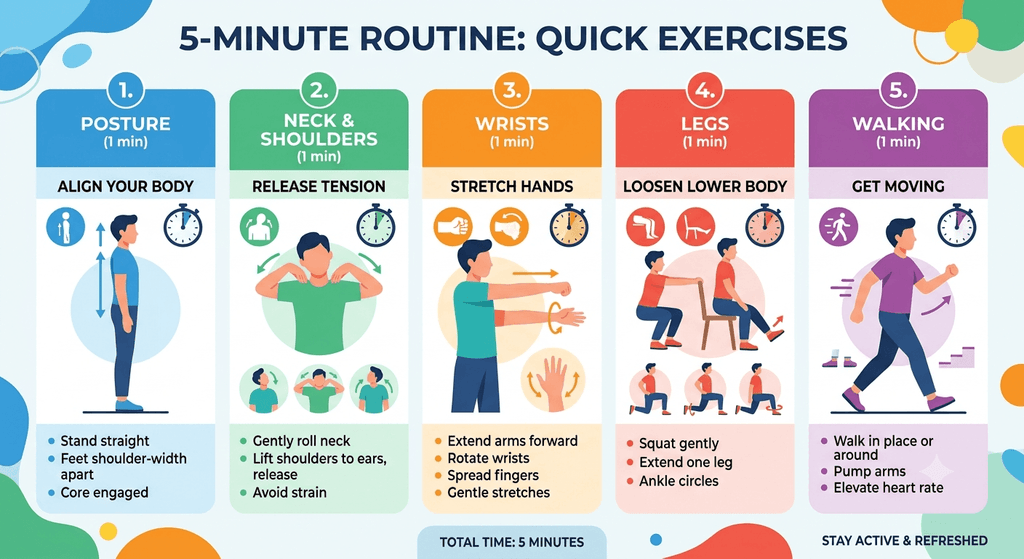
Your 5-Minute Desk Break Routine
Sitting for extended periods can contribute to tight hips, a stiff neck and shoulders, wrist discomfort, and mental fatigue. Taking brief breaks to stand, stretch, and walk may help you stay more comfortable while working.
Mayo Clinic suggests taking movement breaks regularly during the workday, with some guidance recommending simple stretches every 30–45 minutes. The CDC also supports short 5–10 minute activity breaks as a practical way for employees to reduce sedentary time.
A desk break does not need to be intense. The goal is to reset your posture, gently mobilise joints, and give your eyes and mind a short pause.
Before You Start
Keep these safety points in mind:
- Move slowly and avoid forcing any stretch.
- Breathe normally; do not hold your breath.
- Stop if you feel sharp pain, dizziness, numbness, or discomfort.
- Adapt movements for your body and workspace.
- If you have an injury, medical condition, or recent surgery, check with a qualified healthcare professional before starting a new routine.
Your 5-Minute Desk Break Routine
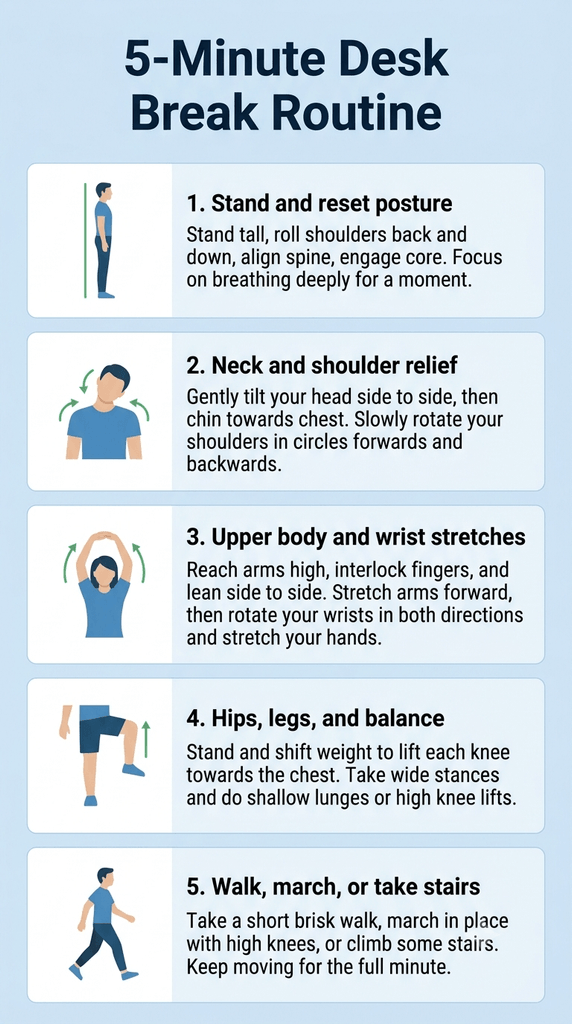
Set a timer for five minutes. Perform each movement for the suggested time, then move to the next one.
Start your 5-Minute Desk Break Routine by standing with your feet
Stand with your feet about hip-width apart. Roll your shoulders back and down, gently lift through the crown of your head, and relax your jaw.
- Stand tall for 15 seconds.
- Slowly roll your shoulders backward 5 times.
- Roll them forward 5 times.
- Take 3 slow, deep breaths.
This first minute helps transition your body out of a seated position and reminds you to release tension in the shoulders and upper back.
Minute 2: Neck and Shoulder Relief
Keep your movements gentle, especially if you have been looking at a screen for a long time.
- Slowly tilt your right ear toward your right shoulder and hold for 15–30 seconds.
- Repeat on the left side.
- Gently turn your head to look right, hold briefly, then look left.
- Finish with 5 slow shoulder rolls.
The Mayo Clinic Health System describes gentle neck movements such as bringing the chin toward the chest, rotating the head side to side, and tilting the ear toward the shoulder, holding each position for 15–30 seconds.
Minute 3: Upper Body and Wrist Stretches
Typing and mouse use can leave your wrists, forearms, chest, and upper back feeling tight.
- Extend your right arm in front of you, palm facing down.
- Gently pull your fingers back with your left hand and hold for 15–30 seconds.
- Repeat with the palm facing up.
- Switch arms.
- Clasp your hands behind your back, open your chest, and hold for 15–30 seconds.
Forearm stretches can be done seated or standing and are especially useful for people who spend much of the day at a keyboard.
Minute 4: Hips, Legs, and Balance
Stand beside your desk or chair for support.
- Hold your desk or chair lightly for balance.
- Bend one knee and bring your heel toward your glutes.
- Hold your ankle gently and hold the stretch for 15–30 seconds.
- Switch legs.
- Stand with feet hip-width apart and slowly twist your upper body left and right.
Mayo Clinic Health System recommends standing quadriceps stretches and gentle seated or standing torso rotations, holding stretches for about 15–30 seconds.
Minute 5: Walk, March, or Take the Stairs
Use the final minute for light movement.
- March in place for 30–60 seconds.
- Walk to refill your water bottle.
- Walk to a colleague’s desk instead of sending a message.
- Take a flight of stairs if it is safe and available.
Standing up, walking, taking stairs, and moving during phone calls are all simple ways to add activity to the workday.
Your 5-Minute Desk Break Routine
A Simple Schedule That Works
You do not need to make your break complicated. Try one of these easy patterns:
| Work pattern | Desk break plan |
| Standard office day | Take a 5-minute break every 60–90 minutes. |
| Long meetings | Stand and stretch for 2–3 minutes between calls. |
| Remote work | Walk around during audio-only calls. |
| Busy deadline days | Do at least one 5-minute routine in the morning and one in the afternoon. |
| Screen-heavy role | Add a brief eye rest by looking away from the screen every 20 minutes. |
The exact timing matters less than consistency. Even one or two short breaks can interrupt a long stretch of sitting and help you return to work with better focus.
Make Desk Breaks a Habit
The best routine is the one you will actually remember. Use these practical tips:
- Add a recurring calendar reminder labelled “Move break.”
- Pair the routine with an existing habit, such as after checking email or before lunch.
- Keep a water bottle nearby so hydration naturally prompts you to stand.
- Invite co-workers to join a brief afternoon movement break.
- Keep the routine visible: save it as a note, sticky note, or phone reminder.
Employers can also help by supporting policies that encourage employees to break up sitting with standing or movement.
Your 5-Minute Desk Break Routine
Common Mistakes to Avoid
- Waiting until you feel pain. Take breaks before stiffness becomes uncomfortable.
- Stretching too aggressively. Gentle movement is enough.
- Skipping breaks on busy days. A shorter 2-minute version is better than none.
- Doing the same movement all day. Alternate neck, shoulder, wrist, hip, and walking breaks.
- Treating desk breaks as exercise. They complement, rather than replace, regular physical activity.
Final Thoughts
Some things in life are very easy to do, but putting them into practice is difficult because they require consistency. For example, waking up early in the morning, eating meals on time, and going to bed on time. None of these things require anyone’s help or any equipment, yet we still struggle to do them consistently. In the same way, the topic of this article, Five-Minute Desk Break, is also similar. However, if we adopt this habit, it can offer numerous benefits, and you may even need to visit the doctor less often.
Follow this practice as part of your daily routine and make it a part of your work. Along with this, if you want to take even better care of your health, make sure to exercise regularly. If exercising regularly every day is not possible, you should exercise at least once a week because, in today’s fast-paced life, everything else takes priority, while a person’s own desires and health are left behind.
Your 5-Minute Desk Break Routine
Stay connected with Groww Tech Education.
Enjoyed this article? Subscribe to Groww Tech Education to stay updated whenever new content is published.
Share this article and our website with your friends, family, and colleagues. Your support helps us reach more readers and grow our learning community.
Visit Groww Tech Education — keep learning, stay inspired, and grow with us!
Frequently Asked Questions
How often should I take a 5-minute desk break?
Can I do this routine at my desk?
Do desk breaks replace exercise?
What if I only have two minutes?
Can desk stretches reduce back and neck stiffness?
Is it okay to do these stretches in office clothes?
Should I stretch if I feel pain?
How can I remember to take breaks?
Are standing desks enough?
Can I do this routine during work hours?
Your 5-Minute Desk Break Routine
Created by-Arun Solanki