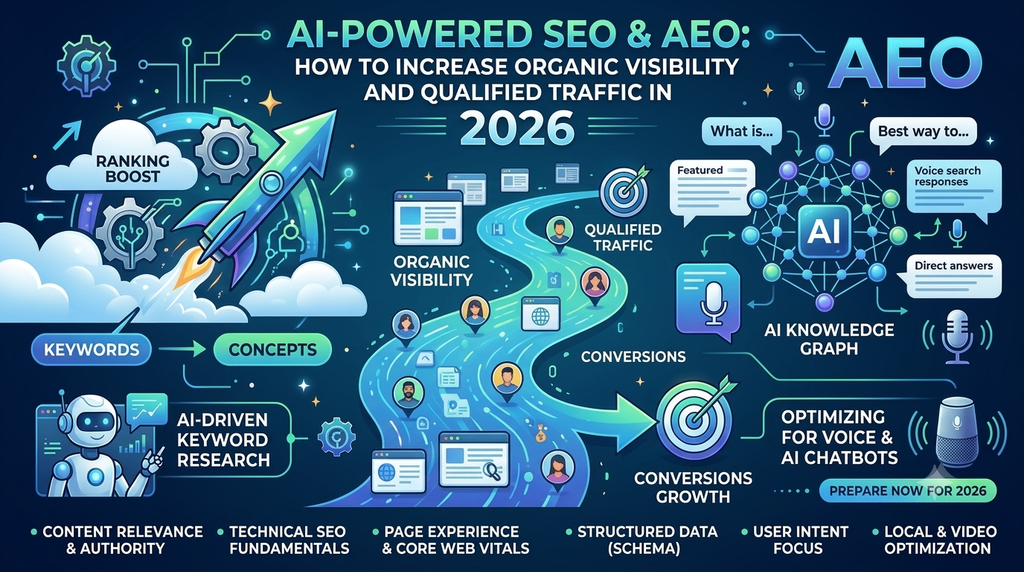
Search has changed. Your customers no longer only scroll through ten blue links—they ask AI assistants, chatbots, and AI-powered search engines for direct answers.
That shift creates a major opportunity. Brands that make their expertise easy to find, understand, and cite can earn visibility in AI answers and attract visitors who are actively looking for solutions.
This guide explains how to combine AI-powered SEO with Answer Engine Optimisation (AEO) to grow qualified organic traffic in 2026.
AI-Powered SEO and AEO
What Is AI-Powered SEO?
AI-powered SEO is optimising your website so both traditional search engines and AI systems can understand, trust, and recommend your content.
It goes beyond inserting keywords into pages. It focuses on topical authority, clear structure, technical accessibility, credible sources, and content that answers real questions.
Google’s own guidance emphasises helpful, reliable, people-first content and accurate structured data that matches what users can see on the page.
What Is AEO?
Answer Engine Optimisation, or AEO, is the process of making your content easy for AI answer engines to extract and cite.
Instead of optimising only for rankings, you optimise for answers. Your goal is to become the source an AI system quotes, summarises, or recommends when someone asks a relevant question.
AEO is especially important because AI-generated answers often rely on content that is well organised, direct, and supported by evidence.
Why AEO Drives Qualified Traffic
AI search attracts high-intent users. Someone asking, “What is the best CRM for a small B2B sales team?” is usually much closer to a buying decision than someone browsing generic marketing content.
When your brand appears in an AI answer, you gain more than visibility. You gain credibility at the exact moment a prospect is evaluating options.
The result is fewer random clicks and more qualified visitors—people who already understand the problem and are looking for a specific solution.
Start With Customer Questions
Strong AEO begins with real customer language, not internal jargon.
Collect questions from sales calls, support tickets, live chat transcripts, reviews, Reddit threads, Quora, and keyword research tools. Group them by intent: awareness, comparison, decision, implementation, and troubleshooting.
Then map each question to a page that gives a complete answer.
For example, if prospects frequently ask, “How much does marketing automation cost?” create a transparent guide that explains pricing models, hidden costs, examples, and buying considerations.
Use an Answer-First Structure
AI systems favour content that is easy to extract. Put the direct answer near the top of each section, then add supporting detail.
A practical format is:
- Open with a 40–60 word direct answer.
- Explain why the answer is true.
- Add examples, data, or a short checklist.
- Link to a deeper resource if needed.
Clear headings matter too. Use question-based H2s and H3s that mirror natural searches, such as “How much does SEO cost?” or “Which SEO metrics matter most?” business.
Make Content Easy to Scan
Long walls of text are difficult for both people and AI systems to process.
Use short paragraphs, descriptive subheadings, bullet points, numbered steps, comparison tables, and bolded key terms. Each section should focus on one idea.
Lists are particularly useful because they make complex guidance easier to summarise. Research on AI-generated answers suggests lists appear frequently, which makes list-based formatting a practical AEO tactic.
Build a Complete Topic Cluster
One strong article is not enough. AI systems look for consistent expertise across related pages.
Create a pillar page around a broad subject, such as “Digital Marketing Strategy“. Then build supporting articles around narrower questions, such as:
- How to create a digital marketing budget
- Best SEO tools for small businesses
- How to measure marketing ROI
- Email automation best practices
- AI marketing tools for content teams
Link each supporting article back to the pillar page using descriptive anchor text. This helps search engines and AI systems understand your area of expertise.
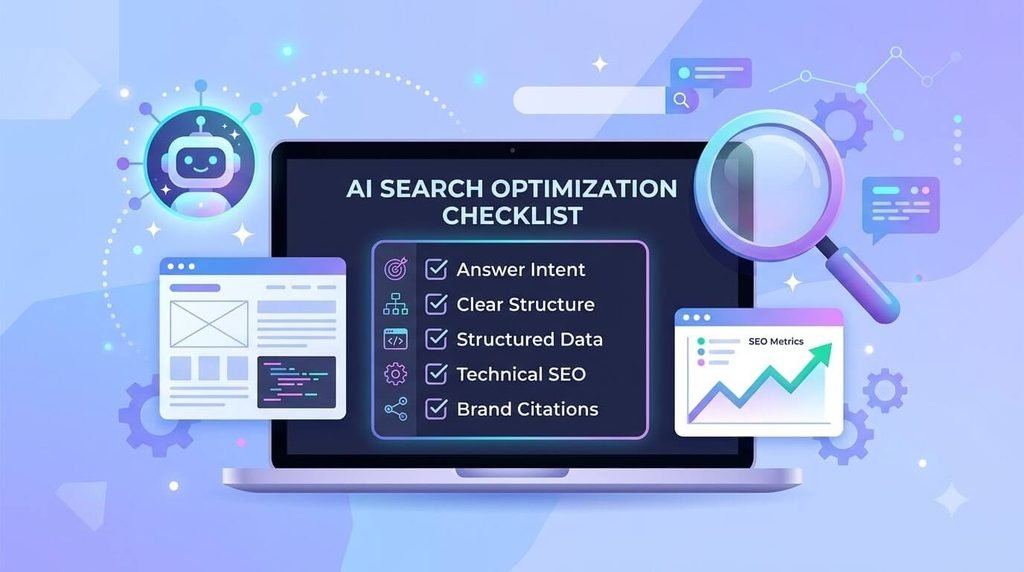
AI Search Optimisation Checklist
AI-Powered SEO and AEO
Use this checklist before publishing or updating a page.
1. Answer one clear question.
Every page should have a primary question and a direct answer. Avoid trying to cover too many unrelated topics on one URL.
2. Lead with the answer
Place a concise summary at the top of the page or section. Expand only after the reader has the core answer.
3. Use question-led headings.
Turn customer questions into headings. This improves readability and helps AI systems identify relevant passages.
4. Add evidence.
Support claims with original research, case studies, expert commentary, customer data, or credible third-party sources. Content that includes data and citations is more likely to be trusted.
5. Keep content current.
Review high-value pages every quarter. Update statistics, screenshots, pricing details, examples, and recommendations.
6. Improve technical accessibility
Ensure important content appears in the initial HTML rather than being hidden behind JavaScript. Check page speed, mobile usability, crawlability, and internal links.
7. Check AI crawler access.
Review your robots.txt and indexing settings to ensure you are not unintentionally blocking AI crawlers that you want to access your public content.
8. Track brand visibility.
Search your priority questions in AI tools and AI-powered search features. Record whether your brand is mentioned, whether the information is accurate, and which competitors appear instead.
AI-Powered SEO and AEO
FAQ Content That Actually Works
AI-Powered SEO and AEO
FAQs are valuable when they answer real questions—not when they exist only to add keywords.
Create FAQs from:
- Sales objections
- Onboarding questions
- Product comparisons
- Pricing concerns
- Compliance or security questions
- Common implementation issues
Keep each answer short, factual, and useful. Add links to detailed guides where appropriate.
For example, instead of writing “Do you offer SEO services?” write: “Yes. Our SEO services include technical audits, keyword research, content strategy, link building, and monthly performance reporting.”
That version gives both users and AI systems more useful context.
Structured Data: Use It Correctly
AI-Powered SEO and AEO
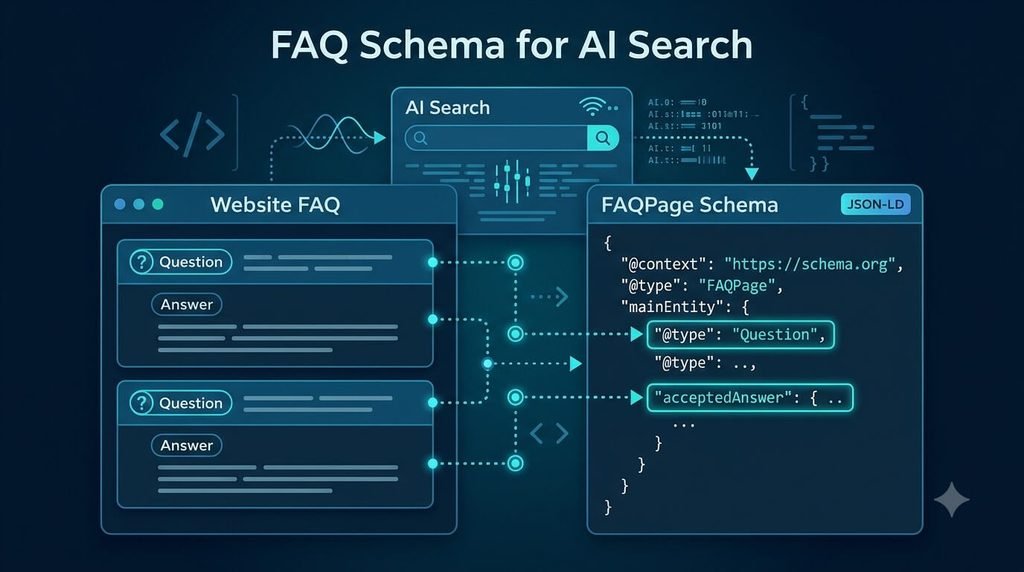
Structured data helps search engines understand the type of content on a page. Relevant schema types include Article, FAQPage, HowTo, Product, Organisation, Person, and Author.
However, structured data is not a magic switch for AI visibility. Google has stated that structured data is not required for AI Overviews or AI Mode, and there is no special schema markup specifically required for those features.
The best approach is simple:
- Use schema that accurately reflects visible page content.
- Validate markup with Google’s Rich Results Test or Schema.org’s validator.
- Avoid marking up content that users cannot see.
- Keep author, organisation, product, and FAQ details consistent across your site.
Brand Citation Tactics
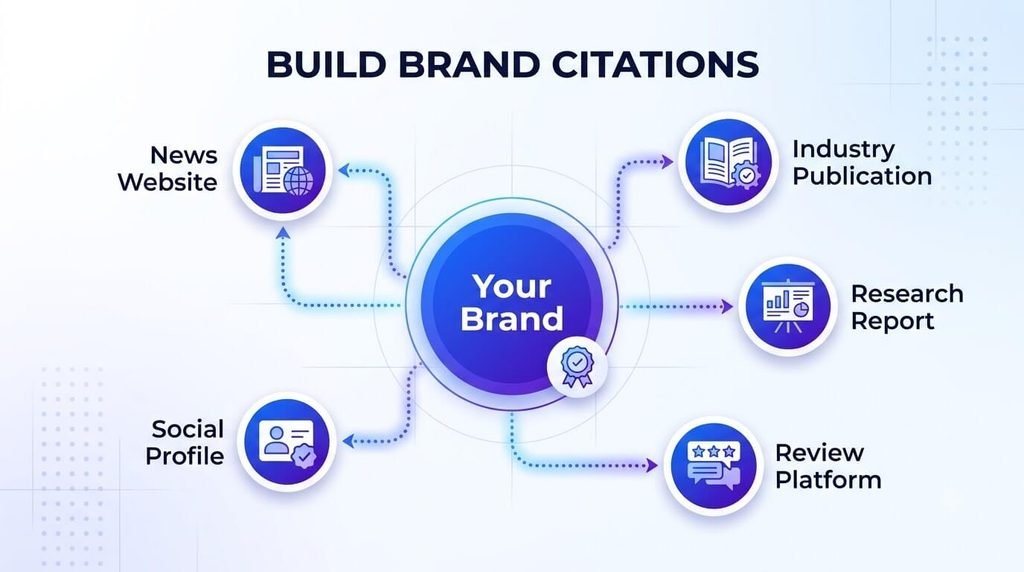
AI systems tend to cite sources they can verify across the web. Your brand needs consistent, credible mentions beyond your own website.
Focus on these tactics:
- Publish original research, surveys, benchmarks, or industry reports.
- Contribute expert commentary to trade publications and relevant news outlets.
- Get listed in credible industry directories and comparison platforms.
- Encourage customer reviews on trusted platforms.
- Maintain accurate business information across your website, LinkedIn, Google Business Profile, and partner sites.
- Correct outdated or inconsistent descriptions of your products and services.
The goal is not to chase random backlinks. It is to build a clear, trustworthy brand entity that AI systems can recognise and cite confidently.
AI-Powered SEO and AEO
Measure What Matters
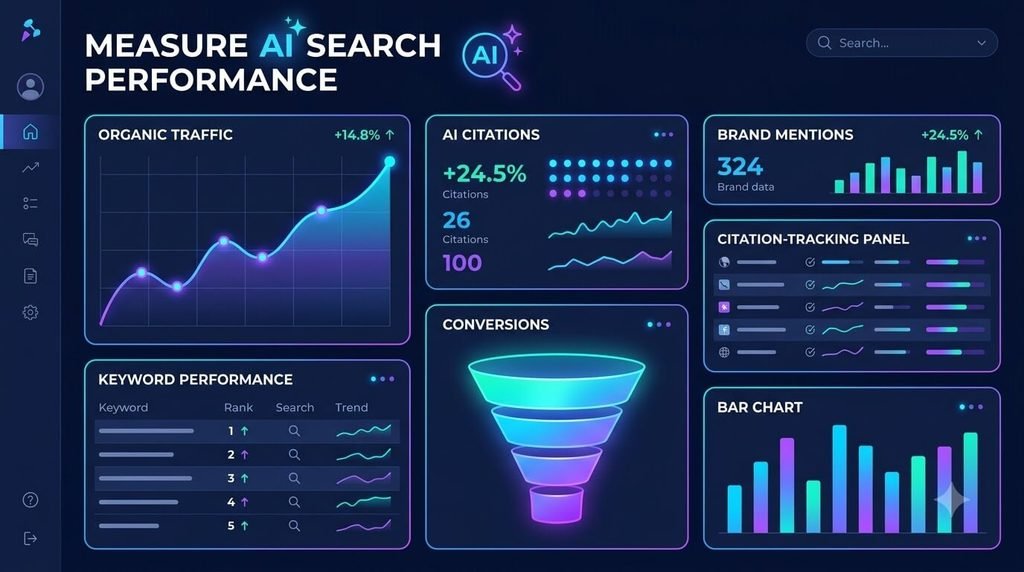
Traditional rankings still matter, but they no longer tell the whole story.
Track these AEO-focused metrics:
- Branded search volume
- AI citation frequency
- Share of answer for priority questions
- Referral traffic from AI platforms
- Organic traffic to answer-led pages
- Leads, demo requests, and revenue from organic sessions
- Accuracy of brand descriptions in AI responses
Review these signals monthly. If competitors are consistently cited for questions you should own, update the page, strengthen the evidence, and improve its structure.
AI-Powered SEO and AEO
Final Thoughts
AI-Powered SEO and AEO
AI-powered SEO and AEO are not replacements for good SEO. They are the next stage of it.
To win in 2026, create genuinely useful content, answer customer questions directly, make your site technically accessible, support claims with evidence, and build credible brand mentions across the web.
Do that consistently, and your brand becomes easier for both people and AI systems to find, trust, and recommend.
FAQs: AI-Powered SEO & AEO
1. What is AI-powered SEO?
2. What is Answer Engine Optimisation (AEO)?
3. How is AEO different from traditional SEO?
4. Why is AEO important in 2026?
5. How do I optimise content for AI search?
6. Does FAQ schema help my content appear in AI Overviews?
7. Should I add FAQ schema to hidden content?
8. What type of questions should I include in FAQs?
9. How long should an FAQ answer be?
10. How can I get my brand cited by AI tools?
11. How do I know if AI tools mention my brand?
12. How often should I update AI-optimised content?
13. Can small businesses benefit from AEO?
14. What metrics should I track for AEO?
Created by Arun Solanki
copyright reserve